AI Coding Interactive Games
Background
Since 2025, I have been exploring how Vibe Coding and AI Coding can support music products, interactive entertainment, and rapid prototyping. For me, AI Coding is not only a productivity tool. It is also a way for designers to participate earlier in product logic, interaction states, and runnable experiences.
Within Tencent Music, I experimented with extending music experiences beyond traditional playback tools into lighter, more playful, and more shareable interactive formats. With AI-assisted coding, I can quickly move an idea from concept, rules, and interface states into a clickable, testable, and demonstrable prototype.
Design Goal
This direction is not about building one complete game. It is about forming a rapid prototyping method for music product innovation:
- Validate whether an interaction idea works in a shorter time;
- Combine music, emotion, visual feedback, and game rules;
- Help product, design, engineering, and business teams understand an idea through a concrete experience;
- Move the designer's role from interface delivery toward experience definition and prototype production.
Prototype Directions
I explored multiple AI Coding prototypes around music interaction and lightweight gamification:
Interactive Playlist Gacha Machine
Turning playlist recommendation into a process of drawing, surprise, and collection, helping users discover music through playful actions.
Mood Slot Machine
Generating music outcomes around emotional states, using slot-machine interaction to create expectation, randomness, and playful feedback.
Music Parkour Game
Combining rhythm, obstacles, and user actions to explore more participatory listening experiences.
Album Cover Match Game
Turning album visuals into playable materials, allowing music content to be remembered and shared through a lightweight game.
3D Polaroid Player and 360-Degree Music Space
Exploring how music players can move from flat interfaces into spatial, interactive, and shareable experience formats.
Method
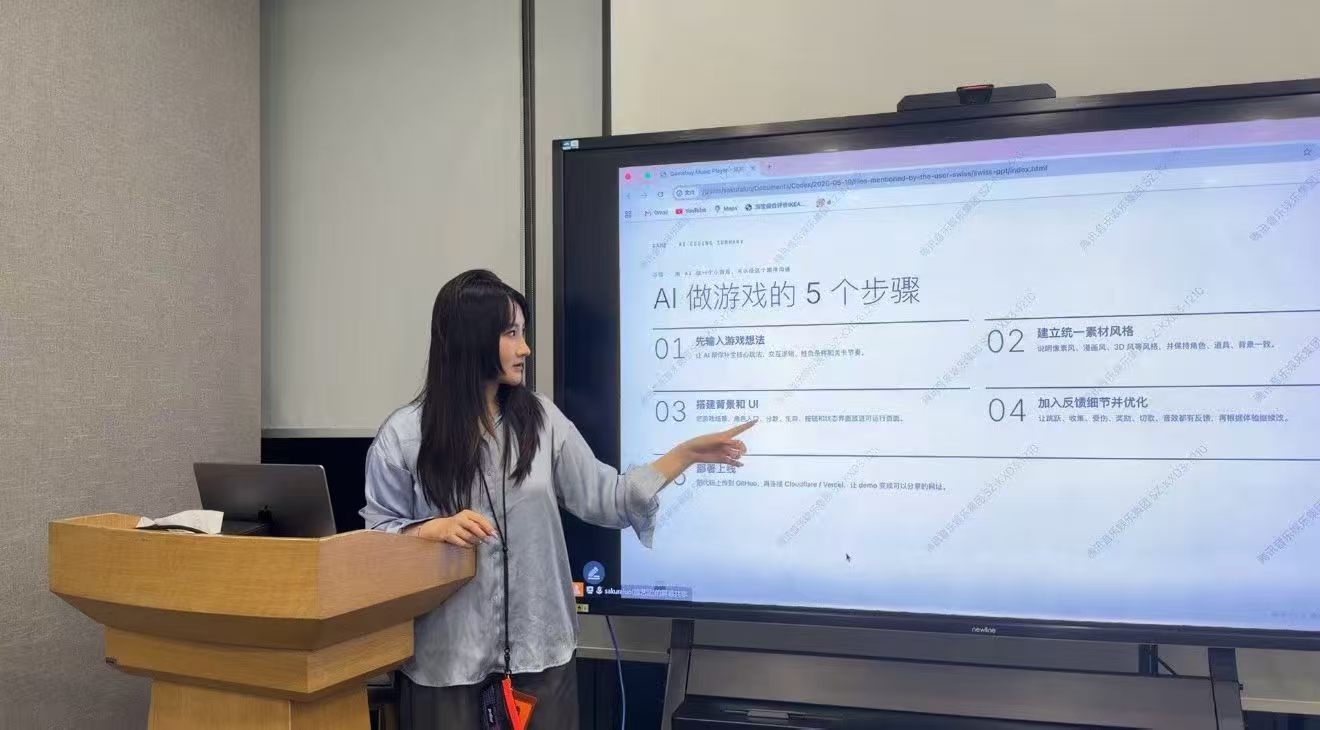
Through these experiments, I gradually formed a workflow for creating interactive games with AI: first define the gameplay goal and core loop, then use AI to generate the base structure, interaction states, and visual direction, and finally iterate through debugging until the prototype moves from "working" to "playable, understandable, and presentable."
I also turned this method into an internal sharing session at Tencent Music Academy, sharing my AI Coding and gamified prototyping process with other designers.
Reflection
AI Coding made me realize more clearly that the future value of designers is not only in expressing ideas through interfaces, but also in defining experience rules, validating interaction logic, and turning abstract concepts into product prototypes that teams can actually feel and discuss.
For music products, this kind of exploration expands listening beyond passive consumption and turns it into an entry point for games, social interaction, emotional expression, and personalized creation.